So, remember how a couple of weeks ago a big-deal study dropped, showing that psilocybin (the stuff in 'magic mushrooms') might be effective in treating depression? (If not, here's a little thing I wrote about it along with the paper itself and other resources.) At the time, the Internet had a lot to say about it. I addressed some of the comments and questions, and then promptly forgot to post my answers.
So here they are now - a bit delayed but nonetheless still useful (I hope).
Do feel free to shoot more questions my way, I love answering the Internet about drugs and brains.
Saturday, June 11, 2016

Wednesday, June 1, 2016
Monday, May 30, 2016
i'm in love with the coco
Right, so, my work recently got an email from a journalist:
I'd love to hear what those in the know have to say about it, btw. I'm only as smart as a ~1hr Google search here.
"I'm writing a feature about cocaine cut with coconut extract doing the rounds, and I was wondering whether I could talk to anyone about the science behind the two being combined, and whether it can impact how safe it is."My reaction (and that of just about anyone I asked) was a general "what the...?!" - especially b/c I later learned that, of all things, this was meant to be an indicator of purity - and my response accordingly read:
"Hi, I'm happy to help if I can, but.... are you sure this is a thing?? Where did you hear about this?"Sure enough though, it turned out to be a thing, and I did my best to answer the questions shot my way (...with a straight face - thankfully they were in writing). I don't know what - if any of it - will make it into the article, but here's what I had to say about that.
I'd love to hear what those in the know have to say about it, btw. I'm only as smart as a ~1hr Google search here.
Monday, May 9, 2016
On hallucinogens and intimate partner violence
One of the latest
papers to come out on the science of psychedelics, published last month in the
Journal of Psychopharmacology, made quite a splash when it suggested that
hallucinogens could have a “protective effect” on intimate partner violence (IPV,
aka domestic violence).
I was asked my opinion on this. I had an opinion or two.
I was asked my opinion on this. I had an opinion or two.
Saturday, May 7, 2016
Whole-plant marijuana study underway at last!
Hooray! From the MAPS press release:
The U.S. Drug Enforcement Administration (DEA) has formally approved the first-ever randomized controlled trial of whole plant medical marijuana (cannabis). The DEA’s approval marks the first time a clinical trial intended to develop smoked botanical marijuana into a legal prescription drug has received full approval from U.S. regulatory agencies, including the DEA and the Food and Drug Administration (FDA).
I wrote a little thing about the study last year. Read on after the jump.
The U.S. Drug Enforcement Administration (DEA) has formally approved the first-ever randomized controlled trial of whole plant medical marijuana (cannabis). The DEA’s approval marks the first time a clinical trial intended to develop smoked botanical marijuana into a legal prescription drug has received full approval from U.S. regulatory agencies, including the DEA and the Food and Drug Administration (FDA).
I wrote a little thing about the study last year. Read on after the jump.
Saturday, January 23, 2016
Saturday, January 16, 2016
Don't believe the hype
By now you've probably heard about the very unfortunate incident in France, where a Serious Adverse Event in a Phase I Clinical Trial left several people hospitalised, one with irreversible brain damage.
While my condolences go out to all involved, my deference to all the Drug War soldiers, rejoicing that it was a cannabis-derived drug (or even, somehow, cannabis?!), does not. Hate to tell ya, but the news were wrong. The drug that was being tested had nothing to do whatsoever with cannabis, any of the compounds in it, or anything derived from it. #sorrynotsorry
Wednesday, June 24, 2015
Marijuana addiction: Is it even a thing??
Whenever
I talk to people about what worries them when it comes to pot, inevitably they
bring up addiction. And let me tell you, addiction is a tragic condition that I
wish on no one and that needs to be taken seriously. But are we sure cannabis addiction is even a thing? Here’s what I
think.
Sunday, June 7, 2015
Changing drug policy - One study at a time.
Ever
wonder why there is so much scientific evidence supporting marijuana’s harms,
but relatively little about its possible benefits?
Last month I got a peek into
the answer (and how the balance is changing) after spending some time with the fine
folks at MAPS – the Multidisciplinary
Association for Psychedelic Studies – at the annual meeting of the American
Psychiatric Association, held this year in Toronto. They had set up their booth
in the conference’s exhibition hall, surrounded by slick pharma displays
promising the next wave of mental health treatment breakthroughs, to tell a
very unique story: that compounds we’ve
had around all along might be the answer…..if only we were allowed to study
them.
Thursday, January 22, 2015
YOU WON'T BELIEVE HOW FAR YOUR JAW WILL DROP
a bunch of people have now separately sent me this article and asked me what i thought.
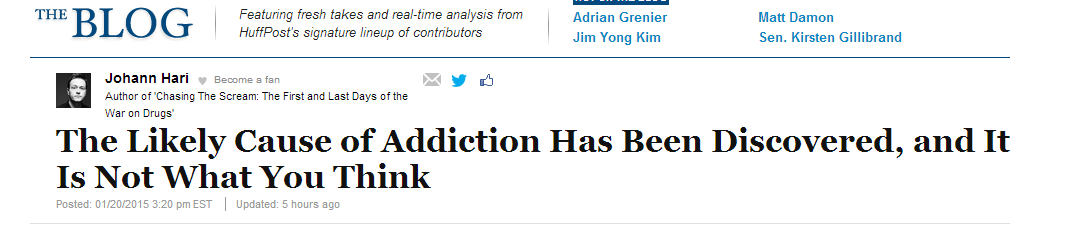
i am so flattered.
*puts on professor doctor hat*
without having read a word of the article, i already thought its clickbait-y, jazzhand-y title was offputting and wrong. there is no one likely cause of addiction. addiction is a bio-psycho-social phenomenon, and no one component is any more important or right or "it" than the others. bio, psycho, and social all interact to create a particularly unfortunate set of circumstances that enable addiction. this isn't news. (or is it? i have so much work to do if it is.)
as for the rest of the article: i was on board for the first bit (except maybe the drama queen tone). rat park is rad. here it is explained in cartoon form (also rad). but as the author went on to clarify his argument, i started to realize that he is just as sadly biased (manipulative?) as the lessons he's trying to debunk. just as the more common teachings leave out the overwhelming percentage of people who use drugs, sometimes regularly, and never get addicted, just sort of "grow out of it," this account leaves out those who DO. i bet you not ALL rats went back to "having a normal life" after being dropped off in rat park. i bet you some small percentage continued their heavy drug use. or maybe not - study rats are inbred. but if we extended this study to people with greater genetic variability or varied personalities, we'd probably arrive at that result.
same with the argument about medical vs. street use of opiates. sure, your brain doesn't care if your opiate is "Rx" or "street," the pharmacology is the same, so something other than "chemical hooks" must be at play. but putting aside the differences in route of administration for a minute (street users tend to shoot or snort = faster more intense effects = more likely to result in compulsive use than hospital administration), i disagree with the idea that street users wind up hooked and patients do not b/c one is isolated and the other has a loving home. you'd be surprised what kind of well-adjusted highly-functional individuals come through my research program meeting full criteria for addiction. take the parkinson's patients for example. (hey check it out i just wrote a paper about this.) sweet, cared-for grandparents, all of them. except that some, as a side effect of their medications, developed impulse control disorders that included problem gambling, hypersexuality, and medication misuse. point being: something other than social environment must be at play, too. and if you want to keep talking about patients using opiate meds: this study tested attention to drug cues in well-behaved pain patients (11% of whom, btw, show signs of misuse), and showed that test scores predicted abuse of meds 3 months later. so 1. don't play like all patients are saints, and 2. attentional bias seems independent from social support so, again, consider other factors.
the thing about the nicotine patch? drug isn't the only thing that triggers craving/relapse. cues and stress do, too. you can't patch those out.
the thing about portugal? maybe decriminalization allowed more people better access to treatment programs.
don't get me wrong, i'm not trying to knock this guy's point. in fact i REALLY REALLY like and stand behind his ultimate message of compassion and connection. what rubs me the wrong way is how his "revelation" (*jazzhands*) about social determinants of addiction dismisses other explanations ("chemical hooks," if you will). in my opinion, the answer isn't in dismissing previously championed views, the answer is in integrating them -- including, yes, more attention to socio-economic environment as a legit driver of addiction.
it's like the story of the blind men each touching a different part of an elephant and thinking they can describe the essence of "elephant." this guy discovered "tail" in a world where most people have been taught "trunk." but neither revelation makes the thing we're talking about any less "elephant," y'know?
i am so flattered.
*puts on professor doctor hat*
without having read a word of the article, i already thought its clickbait-y, jazzhand-y title was offputting and wrong. there is no one likely cause of addiction. addiction is a bio-psycho-social phenomenon, and no one component is any more important or right or "it" than the others. bio, psycho, and social all interact to create a particularly unfortunate set of circumstances that enable addiction. this isn't news. (or is it? i have so much work to do if it is.)
as for the rest of the article: i was on board for the first bit (except maybe the drama queen tone). rat park is rad. here it is explained in cartoon form (also rad). but as the author went on to clarify his argument, i started to realize that he is just as sadly biased (manipulative?) as the lessons he's trying to debunk. just as the more common teachings leave out the overwhelming percentage of people who use drugs, sometimes regularly, and never get addicted, just sort of "grow out of it," this account leaves out those who DO. i bet you not ALL rats went back to "having a normal life" after being dropped off in rat park. i bet you some small percentage continued their heavy drug use. or maybe not - study rats are inbred. but if we extended this study to people with greater genetic variability or varied personalities, we'd probably arrive at that result.
same with the argument about medical vs. street use of opiates. sure, your brain doesn't care if your opiate is "Rx" or "street," the pharmacology is the same, so something other than "chemical hooks" must be at play. but putting aside the differences in route of administration for a minute (street users tend to shoot or snort = faster more intense effects = more likely to result in compulsive use than hospital administration), i disagree with the idea that street users wind up hooked and patients do not b/c one is isolated and the other has a loving home. you'd be surprised what kind of well-adjusted highly-functional individuals come through my research program meeting full criteria for addiction. take the parkinson's patients for example. (hey check it out i just wrote a paper about this.) sweet, cared-for grandparents, all of them. except that some, as a side effect of their medications, developed impulse control disorders that included problem gambling, hypersexuality, and medication misuse. point being: something other than social environment must be at play, too. and if you want to keep talking about patients using opiate meds: this study tested attention to drug cues in well-behaved pain patients (11% of whom, btw, show signs of misuse), and showed that test scores predicted abuse of meds 3 months later. so 1. don't play like all patients are saints, and 2. attentional bias seems independent from social support so, again, consider other factors.
the thing about the nicotine patch? drug isn't the only thing that triggers craving/relapse. cues and stress do, too. you can't patch those out.
the thing about portugal? maybe decriminalization allowed more people better access to treatment programs.
don't get me wrong, i'm not trying to knock this guy's point. in fact i REALLY REALLY like and stand behind his ultimate message of compassion and connection. what rubs me the wrong way is how his "revelation" (*jazzhands*) about social determinants of addiction dismisses other explanations ("chemical hooks," if you will). in my opinion, the answer isn't in dismissing previously championed views, the answer is in integrating them -- including, yes, more attention to socio-economic environment as a legit driver of addiction.
it's like the story of the blind men each touching a different part of an elephant and thinking they can describe the essence of "elephant." this guy discovered "tail" in a world where most people have been taught "trunk." but neither revelation makes the thing we're talking about any less "elephant," y'know?
Wednesday, January 7, 2015

Monday, June 24, 2013
a medication for mindfulness?
i just got back from the annual CPDD conference. this was probably the most provocative slide of the entire conference. i'm pretty sure it was from a talk given by this fella (although with a week having passed since, i can't be sure, and i can't find the abstract), in a really cool session titled "NEW DIRECTIONS IN THE PHARMACOLOGICAL FACILITATION OF PSYCHOTHERAPY FOR DRUG DEPENDENCE." anyway i thought it was worth sharing, you can probably hit him up for the details.

Monday, June 10, 2013
alphabetamines talk
i gave a talk about the neuroscience of novel synthetic drugs at the 2013 Club Health Conference some weeks ago. spice, bath salts, that sort of thing. then i plain-language'd the slides and put them on the internet. you can download them here.

Tuesday, February 5, 2013
psychedelics as pharmacotherapy
Two articles in my Google Reader caught my eye this morning:
Ecstasy, the Marriage Counsellor of Tomorrow
Can Magic Mushrooms Help Cancer Patients?
The first reports on a study that argues we're not evolutionarily built to survive romantic relationships because we simply live too long, so why not consider "love drugs" as an aid to make it together to the end. (as an aside: drugs alone are never the answer! although they can be a terriffic adjunct to long-term behavioural therapy.) The second reports on a book/study exploring the use of psilocybin to alleviate the distress associated with cancer diagnosis.
In both cases, the authors surely raise eyebrows by suggesting that currently illegal drugs with "no accepted medical use" and "high abuse potential" may actually have value when used in therapeutic settings. The notion is neither new nor radical to me, but to a public used to a 'Schedule I = bad' mantra, probably pretty racey. But from a neurobio perspective, I don't see a whole lot wrong with it. Neither article advocates using the drug more than a handful of times, and no addiction has ever arisen from a handful of times. Addiction is an acquired disorder that develops with repeated use and eventually turns compulsive -- not likely to happen when used on an irregular, occasional basis. Even the studies of "seasoned" ecstasy or psilocybin users I've seen tend to report patterns of moderate, weekend use, rather than the kinds of compulsive binges you see with other psychostimulants. And nevermind that hallucinogens such as psilocybin have not been shown to have a dopaminergic reward/reinforcement component, so are not likely to result in addiction altogether. With ecstasy, sure, there are cardiovascular risks or the potential for overheating, it's an amphetamine after all; but again, with the doses implied for these purposes, not likely. And brain damage? If you're picturing studies that pit a drug-using against a healthy brain, consider that the drug-using subjects are selected for heightened use duration or severity, and that the healthy comparison subjects in many cases are allowed a handful of occasions of use in their lifetime -- so the marriage-ecstasy/cancer-mushroom brains are going to look more like the controls than the users.
Of course I'm sure the policy implications are tricky (it's probably hard to allow medical use without unleashing a reckless free-for-all), but can we at least ease up on the "no medical value" mantra so we can see if maybe we've been wrong all along? I don't see the harm in at least finding out.
In any case, I wonder if it's a coincidence that both articles appeared on the same day, or if it's a sign of a turning tide.
Sunday, January 27, 2013
Weed or Wheel!
Research Article: Weed or Wheel! fMRI, Behavioural, and Toxicological Investigations of How Cannabis Smoking Affects Skills Necessary for Driving
Article here. Abstract:
This article recently caught my eye, and it's pissing me off. Mind you, I don't think PLOS One is the most reputable of sources, but this may not be known beyond academic circles, and any policy-maker will be happy to choose this article over another that may be more difficult to access or extract a message from. And therein lies the problem: It's not that the article is bad, per se. The rationale seems sound, the methodology is acceptable, even the results are fine. What's rubbing me the wrong way is the obvious political agenda, and the way it is snuck into the interpretation and discussion -- and undeservedly so. The sweeping, politically charged conclusions are not at all supported by the data, so even though the data themselves are fine, this kind of aggrandization is dangerous in my opinion. I'm surprised to see this coming out of Europe, where I like to tell myself they're more enlightened about drug research. Sigh.
So let's start with the results. In a nutshell, the investigators had subjects smoke pot vs. a placebo joint, and perform an out-of-scanner object tracking task that has shown some relationship to real-life driving, an in-scanner tracking task while brain activity was measured with functional MRI, and self-reports of high, confusion, confidence in ability to drive, etc. Self-reported effects went as expected after pot compared to placebo, and performance on the tracking tasks decreased. During the in-scanner task, a lot of brain regions predictably involved in task performance showed lower activity after pot vs placebo, and a few showed higher activity. And in some of those regions, activity correlated with self-reported confusion. I may have missed a few, but that's the basic gist of it.
The point of contention is with the statements they make in the interpretation of the data. The abstract alone (which, presumably, is all a policy-maker will read before making a decision) feels like a heap of half-truths and manipulation.
"Our goal was to evaluate the impact of cannabis on the driving ability of occasional smokers, by investigating changes in the brain network involved in a tracking task." I don't think this is a fair description of the rationale for the study. They may well have wanted to investigate the effects of cannabis on brain networks involved in a tracking task, but everything in between is pure conjecture. We don't know if the tracking task has ANYTHING to do with driving ability, in the absence of a test that involves.....actual driving. The out-of-scanner tracking task they use has a "moderate correlation with real-world driving," but that's not the one that was used in the scanner, and they never test if performance on the two tasks correlates with each other, let alone actual driving.
"We show that cannabis smoking, even at low Δ9-Tetrahydrocannabinol blood concentrations, decreases psychomotor skills and alters the activity of the brain networks involved in cognition." This statement isn't entirely unfair, but I don't see how it deserves to be applied specifically to driving. The evidence suggests that subjects were feeling more generally "confused" after cannabis, which could also impair their ability to walk on a crowded sidewalk, or mow their lawn, or play chess. Why isn't the article focused on those?
"Subjects are more attracted by intrapersonal stimuli (“self”) and fail to attend to task performance, leading to an insufficient allocation of task-oriented resources and to sub-optimal performance." This statement is the authors' interpretation based ENTIRELY on the brain regions that were activated/deactivated. But brain regions tend to be involved in more than one thing (including, but far from limited to, the thing that is convenient for the interpreter), and it seems overreaching to make it sound like a sure result in the absence of having tested any of these things.
"These findings bolster the zero-tolerance policy adopted in several countries that prohibits the presence of any amount of drugs in blood while driving." This is the one that got me. I mean, what?! Until someone gets a research subject high and puts them in a driving simulator, this is a HUGE leap in logic. How does decreased performance on an in-scanner tracking task translate to real-world driving behaviour? It can't be the only factor that goes into driving, and maybe people can recruit other resources to compensate for impairment when their safety is actually on the line, and just as there is a low blood alcohol level that is considered "safe" for the roads (but surely impairs task performance too), shouldn't it be tested if there is a dose-response relationship for cannabis too before calling for a zero tolerance policy? (I mean, don't get me wrong, I am NOT in favour of impaired driving, and firmly believe that no one has the right to make their intoxication anybody else's problem. But I am equally not in favour of skewed statements with little basis. If you're going to broadcast claims to the world, they should at least be backed up.)
Also, I find the conclusion of the manuscript entirely schizophrenic: "...we failed to find any quantitative correlation between the THC levels measured in whole blood and either the BOLD signal or the psychomotor performance. These results bolster the “zero tolerance policy” that prohibits the presence of any amount of THC in the blood while driving." If self-reported confusion correlated with outcome measures, but THC in the system didn't.....wouldn't it make more sense to call for a zero tolerance policy on confusion?
In all seriousness, though, the paper certainly deserves a spot in the Journal of Proofs of Concept with Potential Implications for the Real World; it's not groundbreaking, but it IS the sort of thing that policies should be built on. But to scoop up a bucket of sand and call it a sandcastle is not just unprofessional, but in this case, potentially detrimental to evidence-based policy progress.
Article here. Abstract:
Battistella G, Fornari E, Thomas A, Mall J-F, Chtioui H, et al. (2013) Weed or Wheel! fMRI, Behavioural, and Toxicological Investigations of How Cannabis Smoking Affects Skills Necessary for Driving. PLoS ONE 8(1): e52545. doi:10.1371/journal.pone.0052545
Marijuana is the most widely used illicit drug, however its effects on cognitive functions underling safe driving remain mostly unexplored. Our goal was to evaluate the impact of cannabis on the driving ability of occasional smokers, by investigating changes in the brain network involved in a tracking task. The subject characteristics, the percentage of Δ9-Tetrahydrocannabinol in the joint, and the inhaled dose were in accordance with real-life conditions. Thirty-one male volunteers were enrolled in this study that includes clinical and toxicological aspects together with functional magnetic resonance imaging of the brain and measurements of psychomotor skills. The fMRI paradigm was based on a visuo-motor tracking task, alternating active tracking blocks with passive tracking viewing and rest condition. We show that cannabis smoking, even at low Δ9-Tetrahydrocannabinol blood concentrations, decreases psychomotor skills and alters the activity of the brain networks involved in cognition. The relative decrease of Blood Oxygen Level Dependent response (BOLD) after cannabis smoking in the anterior insula, dorsomedial thalamus, and striatum compared to placebo smoking suggests an alteration of the network involved in saliency detection. In addition, the decrease of BOLD response in the right superior parietal cortex and in the dorsolateral prefrontal cortex indicates the involvement of the Control Executive network known to operate once the saliencies are identified. Furthermore, cannabis increases activity in the rostral anterior cingulate cortex and ventromedial prefrontal cortices, suggesting an increase in self-oriented mental activity. Subjects are more attracted by intrapersonal stimuli (“self”) and fail to attend to task performance, leading to an insufficient allocation of task-oriented resources and to sub-optimal performance. These effects correlate with the subjective feeling of confusion rather than with the blood level of Δ9-Tetrahydrocannabinol. These findings bolster the zero-tolerance policy adopted in several countries that prohibits the presence of any amount of drugs in blood while driving.
This article recently caught my eye, and it's pissing me off. Mind you, I don't think PLOS One is the most reputable of sources, but this may not be known beyond academic circles, and any policy-maker will be happy to choose this article over another that may be more difficult to access or extract a message from. And therein lies the problem: It's not that the article is bad, per se. The rationale seems sound, the methodology is acceptable, even the results are fine. What's rubbing me the wrong way is the obvious political agenda, and the way it is snuck into the interpretation and discussion -- and undeservedly so. The sweeping, politically charged conclusions are not at all supported by the data, so even though the data themselves are fine, this kind of aggrandization is dangerous in my opinion. I'm surprised to see this coming out of Europe, where I like to tell myself they're more enlightened about drug research. Sigh.
So let's start with the results. In a nutshell, the investigators had subjects smoke pot vs. a placebo joint, and perform an out-of-scanner object tracking task that has shown some relationship to real-life driving, an in-scanner tracking task while brain activity was measured with functional MRI, and self-reports of high, confusion, confidence in ability to drive, etc. Self-reported effects went as expected after pot compared to placebo, and performance on the tracking tasks decreased. During the in-scanner task, a lot of brain regions predictably involved in task performance showed lower activity after pot vs placebo, and a few showed higher activity. And in some of those regions, activity correlated with self-reported confusion. I may have missed a few, but that's the basic gist of it.
The point of contention is with the statements they make in the interpretation of the data. The abstract alone (which, presumably, is all a policy-maker will read before making a decision) feels like a heap of half-truths and manipulation.
"Our goal was to evaluate the impact of cannabis on the driving ability of occasional smokers, by investigating changes in the brain network involved in a tracking task." I don't think this is a fair description of the rationale for the study. They may well have wanted to investigate the effects of cannabis on brain networks involved in a tracking task, but everything in between is pure conjecture. We don't know if the tracking task has ANYTHING to do with driving ability, in the absence of a test that involves.....actual driving. The out-of-scanner tracking task they use has a "moderate correlation with real-world driving," but that's not the one that was used in the scanner, and they never test if performance on the two tasks correlates with each other, let alone actual driving.
"We show that cannabis smoking, even at low Δ9-Tetrahydrocannabinol blood concentrations, decreases psychomotor skills and alters the activity of the brain networks involved in cognition." This statement isn't entirely unfair, but I don't see how it deserves to be applied specifically to driving. The evidence suggests that subjects were feeling more generally "confused" after cannabis, which could also impair their ability to walk on a crowded sidewalk, or mow their lawn, or play chess. Why isn't the article focused on those?
"Subjects are more attracted by intrapersonal stimuli (“self”) and fail to attend to task performance, leading to an insufficient allocation of task-oriented resources and to sub-optimal performance." This statement is the authors' interpretation based ENTIRELY on the brain regions that were activated/deactivated. But brain regions tend to be involved in more than one thing (including, but far from limited to, the thing that is convenient for the interpreter), and it seems overreaching to make it sound like a sure result in the absence of having tested any of these things.
"These findings bolster the zero-tolerance policy adopted in several countries that prohibits the presence of any amount of drugs in blood while driving." This is the one that got me. I mean, what?! Until someone gets a research subject high and puts them in a driving simulator, this is a HUGE leap in logic. How does decreased performance on an in-scanner tracking task translate to real-world driving behaviour? It can't be the only factor that goes into driving, and maybe people can recruit other resources to compensate for impairment when their safety is actually on the line, and just as there is a low blood alcohol level that is considered "safe" for the roads (but surely impairs task performance too), shouldn't it be tested if there is a dose-response relationship for cannabis too before calling for a zero tolerance policy? (I mean, don't get me wrong, I am NOT in favour of impaired driving, and firmly believe that no one has the right to make their intoxication anybody else's problem. But I am equally not in favour of skewed statements with little basis. If you're going to broadcast claims to the world, they should at least be backed up.)
Also, I find the conclusion of the manuscript entirely schizophrenic: "...we failed to find any quantitative correlation between the THC levels measured in whole blood and either the BOLD signal or the psychomotor performance. These results bolster the “zero tolerance policy” that prohibits the presence of any amount of THC in the blood while driving." If self-reported confusion correlated with outcome measures, but THC in the system didn't.....wouldn't it make more sense to call for a zero tolerance policy on confusion?
In all seriousness, though, the paper certainly deserves a spot in the Journal of Proofs of Concept with Potential Implications for the Real World; it's not groundbreaking, but it IS the sort of thing that policies should be built on. But to scoop up a bucket of sand and call it a sandcastle is not just unprofessional, but in this case, potentially detrimental to evidence-based policy progress.
Sunday, November 18, 2012

Saturday, June 2, 2012
snippets. one day i hope to generate original content again.
looks like the already-brilliant University of Utah Genetic Science Learning Center has added a ton of interactive activities to their even-more-brilliant (if only b/c i get it :)) site on addiction. go play!! (mouse party is probably still my favourite, but some of the others will also make you crack a smile.
in other news: this is a great article b/c the sound bites are spot-on (i wish i could be so concise and articulate about such a tricky subject) and i want the book. the inability to just FIND OUT what goes on in the brain with certain drugs (and, god forbid, eventually base policy on it) has been on my mind a lot, so i'm excited to see the idea get publicity.
also: this article touches on a lot of issues dear to me, including media hysteria, the importance of a little knowledge (and patience), and unintended negative consequences of policy on public opinion and action. well done, i say.
Sunday, May 13, 2012
video of me going on about addiction. and a good look up my nose.
here's a video of a talk i gave a couple of weeks back at Addictions Rounds to an audience of clinicians/treatment providers and researchers: "Addiction Neuroimaging: What is known, and (how) can it be used?"
unfortunately the beginning got cut off. missing slides after the jump.
unfortunately the beginning got cut off. missing slides after the jump.
Sunday, March 4, 2012
on opiate risk reduction
a couple of days ago, i posted on a message board, following the loss of a member of the detroit dance community to a seemingly out-of-the-blue OD (then again, doesn't it always seem out of the blue....). in any event, someone suggested i re-post it here, and i thought, why not! so, voilà. maybe it'll help me kick-start this thing back up like i've been meaning to for the past, oh, 2 years....... click below for the post.
Wednesday, June 30, 2010
On history repeating itself

Rather than going through this cycle again over the next decade or so (face it, kids will rave. You take away their legal options, a black market will form, and it will be all the more unregulated and unsafe), I think it is time for the people running these events to take some of the responsibility. Yes, I'm sure throwing events of this scale is hard, and I don't know the half of what goes into it, and finding ways to prevent a bunch of teenage schmucks from sneaking in drugs just isn't very high on the to-do list. But we can't leave it up to the kids, or even their parents. Teenagers are notoriously bad decision-makers, and parents more often than not are not only uneducated, but also clueless about their kids' activities. Do you really think mom dropped them off looking like that? Chances are that is not how they left the minivan. I mean, maybe they did, but I know my parents had rules, and yet I can't tell you how many times 16-year-old me "spent the night at Keli's house" only to find myself in an abandoned downtown Detroit warehouse, inhaling asbestos and making bad choices. So for the times parental supervision and the emotional and cognitive maturity of teenagers fail us, I think the entities responsible for event promotion, media coverage, and discussion should step up and take some initiative. Maybe a required crash course in "avoiding potential harms of drugs" that people have to click through before being able to purchase their tickets. Maybe on-site peer education. Maybe blogs that focus on ways to be safe, in addition to their DJ reviews and the inevitable creepshow photo galleries of teen asses. Maybe just less of a laissez-faire atmosphere (I don't mean policing, but when MCs have to get on the mic and tell people to stop acting like assholes, people are acting like assholes. Make it clear from the get-go that that won't be tolerated).
Any way you cut it, what I find the most unacceptable notion of all is exemplified in news story paragraphs that start like this: "Although many partygoers consider ecstasy to be safe,...." Why have people not picked up a more nuanced understanding of this over the past decade? And while I applaud thought experiments about future improvements, I wonder, who is going to actually take the initiative, and what is it going to look like?
Subscribe to:
Posts (Atom)